
Owner's guide
How to choose a prestige car transporter
Every operator says they're careful. Here are the seven things that actually separate them, and the questions that get you a straight answer in under a minute.
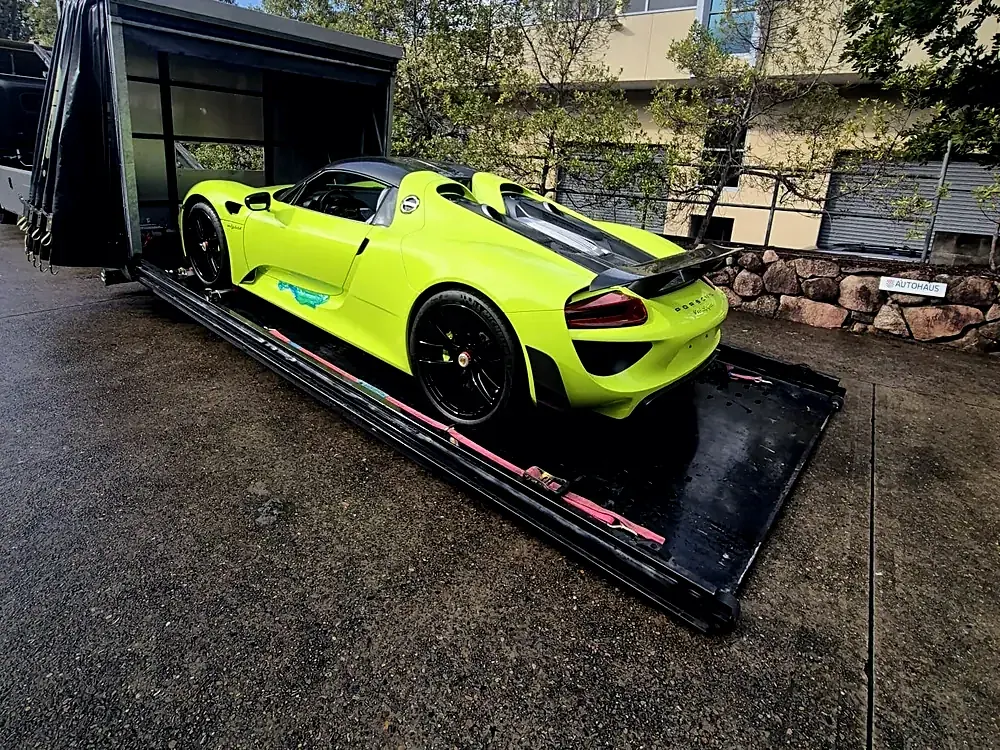
The problem with "we're fully insured and very careful"
Every transport website says it. None of it is checkable, which is exactly why it gets said. The operators who are genuinely set up for low, wide, expensive cars can answer specific questions with specific numbers, and the ones who aren't will change the subject to how long they've been in business.
So the useful move isn't reading marketing copy. It's asking seven questions. Below is what to ask, why it matters, and our own answer to each, so you can see we're not hiding behind the same vagueness.
The seven questions
| Ask them | Why it matters | Our answer |
|---|---|---|
| "What load angle does your tray achieve?" | The single number that decides whether a lowered car boards without scraping. Most standard tilt trays sit around 10–12°. Under about 6° is where low cars stop being a problem. | 4 degrees. On the open trucks, not just the enclosed one. |
| "Do you strap the wheels or the chassis?" | Chassis and suspension straps load the car's structure and can mark control arms or sills. Over-the-tyre strapping puts the force through the tyre, where it belongs. | Soft straps over the tyres. Nothing metal touches paint or panel. |
| "Who is actually driving my car onto the truck?" | Larger operators subcontract. The person you spoke to is often not the person who handles a $400k car on a wet ramp at 6am. | You speak to the owner, and the person who quotes your job is responsible for it end to end. |
| "What cover applies while my car is on your truck?" | Public liability is not the same thing as cover for the vehicle in transit. Ask which one applies to your car specifically, and ask to see the certificate. | Both in-transit cover and public liability. Certificates provided on request before booking. |
| "Can you get into my building's basement?" | Height limits defeat a lot of equipment. Enclosed trailers in particular often can't enter apartment car parks, so the car gets driven out to the street first, by someone else. | Open trays access most basements. If clearance is tight we tell you before the day, not on it. |
| "Is the price quoted the price I pay?" | Watch for after-hours loading, waiting time, tolls and access surcharges appearing later. Ask for the total, in writing. | Quoted per job, in writing, before we commit. Rates vary by distance and access. |
Two things worth more than any answer
Ask for photos of their last job. Not stock imagery, not a truck parked in a showroom. A real car on their real truck, strapped. An operator who does this work properly has hundreds on their phone and will send one in thirty seconds.
Watch how they answer the angle question. If it gets a number, they've measured it and they're proud of it. If it gets "yeah mate, no worries, we do low cars all the time," they haven't, and your splitter is about to find out.
When cheapest is genuinely fine
Not every job needs any of this. A standard-ride-height car moving across town on a dry day is a commodity tow, and paying a premium for it is money you didn't need to spend. This checklist earns its keep when the car is low, wide, rare, very expensive, or irreplaceable, where the cost of one mistake is larger than the entire transport bill for a year.
That's the honest test: if the car scraping would ruin your week, ask the seven questions. If it wouldn't, book whoever is closest.
Good to know.
What load angle do I need for a lowered car?
As a rule of thumb, under about 6 degrees. Standard tilt trays commonly sit near 10-12 degrees, which is where splitters, lips and long-overhang GT cars make contact. Ask for the number rather than a reassurance.
Is enclosed transport always better for an expensive car?
No. Enclosed protects against weather, road debris and being seen, so it suits concours cars, long interstate runs and anything genuinely irreplaceable. For most prestige cars moving around Sydney, a proper low-angle open tray with soft straps is the right call.
How do I check a transporter's insurance?
Ask specifically whether the cover applies to your vehicle while it's on their truck, since public liability alone does not. Then ask for the certificate of currency. A professional operator sends it without hesitating.